As an Amazon Associate, we earn from qualifying purchases. Some links on this site are affiliate links at no extra cost to you. Our recommendations are based on thorough research and editorial judgment.

Practical Lumens Targets for Common Bathroom Sizes

Practical lumens targets for common bathroom sizes vary greatly, with small bathrooms (up to 40 sq ft) requiring approximately 1,500 to 2,000 lumens for adequate illumination, while medium bathrooms (40 to 100 sq ft) need about 2,000 to 4,000 lumens. Large bathrooms (over 100 sq ft) aim for 4,000 to 8,000 lumens. These values help guarantee comfort, functionality, and safety. Proper lighting design considers various factors; understanding these will enhance your bathroom’s atmosphere and usability.
Key Takeaways
- Small bathrooms (up to 40 sq ft) require 1,500 to 2,000 lumens for adequate illumination.
- Medium bathrooms (40 to 100 sq ft) need 2,000 to 4,000 lumens for optimal brightness.
- Large bathrooms (over 100 sq ft) should aim for 4,000 to 8,000 lumens for effective lighting.
- To calculate lumens, multiply the bathroom’s square footage by the recommended foot-candle range of 70 to 100.
- Consider natural light and room features, adjusting lumen targets as necessary based on environmental factors.
Understanding Lumens in Bathroom Lighting
You may be interested



When evaluating bathroom lighting, understanding lumens is crucial, as they represent the total light output from a fixture, enabling homeowners to make informed decisions about brightness levels. A small bathroom, typically up to 40 square feet, requires between 1,500 to 2,000 lumens to sufficiently illuminate the space. In medium-sized bathrooms, measuring between 40 to 100 square feet, the lighting needs increase to 2,000 to 4,000 lumens for peak visibility. Large bathrooms, exceeding 100 square feet, necessitate a range of 4,000 to 8,000 lumens to guarantee adequate brightness for various grooming tasks. Properly understanding lumens allows homeowners to choose appropriate fixtures that meet their bathroom typical needs, thereby enhancing functionality and comfort within this essential space. Many LED vanity lights offer energy-efficient features that reduce electricity costs and extend the lifespan of the fixture.
Factors Affecting Lumen Requirements
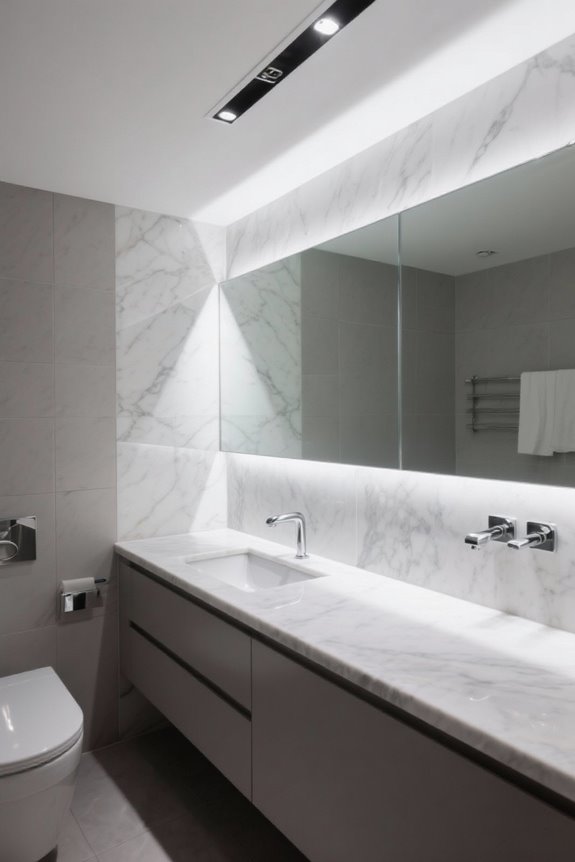
Several factors affect lumen requirements in bathroom lighting, with size and layout being paramount; for example, a compact bathroom of 30 square feet typically requires about 1,500 lumens, while a more spacious bathroom exceeding 120 square feet may need as much as 6,000 lumens for ideal brightness. Additionally, the presence of natural light from windows can greatly decrease artificial lighting needs. Vanity size and mirror dimensions also influence overall lumen requirements, as larger mirrors and vanities necessitate increased illumination for grooming tasks. Ambient lighting, providing general visibility, should be balanced with task lighting, which focuses on specific areas for detailed activities like shaving and makeup application, ensuring adequate brightness without overly bright or dim spots. For bathroom mirrors, HD explosion-proof glass is a valuable feature that enhances safety and durability by minimizing shattering risks.
Importance of Bathroom Size and Layout
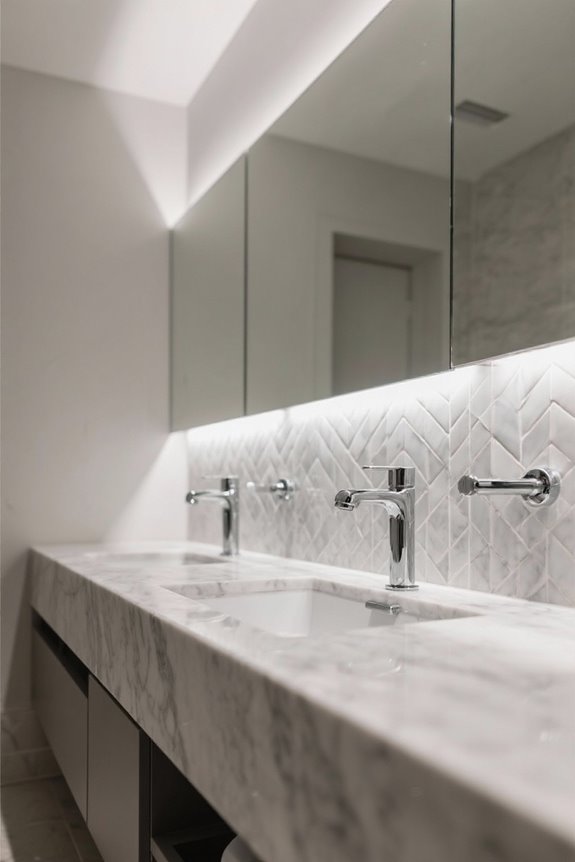
Understanding the importance of bathroom size and layout is essential for achieving ideal lighting, as both directly influence the amount of lumens required to adequately illuminate the space. Smaller bathrooms, typically up to 40 square feet, may require around 1,500 to 2,000 lumens, while medium-sized bathrooms, ranging from 40 to 100 square feet, demand 2,000 to 4,000 lumens. Larger bathrooms exceeding 100 square feet necessitate illumination of 4,000 to 8,000 lumens for peak functionality. Additionally, layout features like windows, mirrors, and the dimensions of vanities can enhance or diminish lighting efficiency. A balanced combination of ambient and task lighting is crucial to eliminate dim areas, ensuring sufficient illumination for grooming tasks and general use in the bathroom setting. For bathrooms, it’s advisable to consider fixtures with IP44 waterproof rating to ensure safety and durability in humid environments.
Standard Lumen Recommendations by Bathroom Size
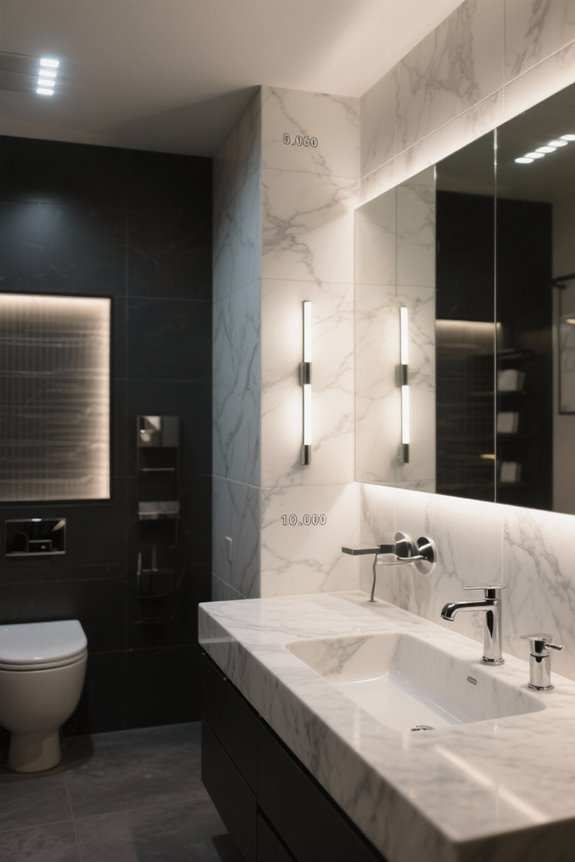
Achieving effective lighting in bathrooms relies greatly on adhering to standard lumen recommendations based on the size of the space. For a small bathroom, typically defined as being up to 40 square feet, the lumens needed range from 1,500 to 2,000. This amount guarantees adequate brightness for tasks such as shaving or makeup application. In contrast, medium bathrooms, which measure between 40 to 100 square feet, require approximately 2,000 to 4,000 lumens for ideal lighting conditions. This range accommodates a broader array of activities and enhances the overall functionality of the space. Larger bathrooms, exceeding 100 square feet, should aim for 4,000 to 8,000 lumens, although this discussion focuses primarily on smaller and medium bathrooms. Consider using energy-efficient fixtures that can lead to significant savings on energy costs, with reductions up to 85%.
Recommended Products

The Fusion collection offers a selection of Handcrafted Artisan glass shades. These beautiful Artisan glass finishes complement the clean designs of Justice design Fixtures

The Fusion collection offers a selection of Handcrafted Artisan glass shades. These beautiful Artisan glass finishes complement the clean designs of Justice design Fixtures

LED Vanity from Rockne collection
Calculating Lumens for Optimal Brightness
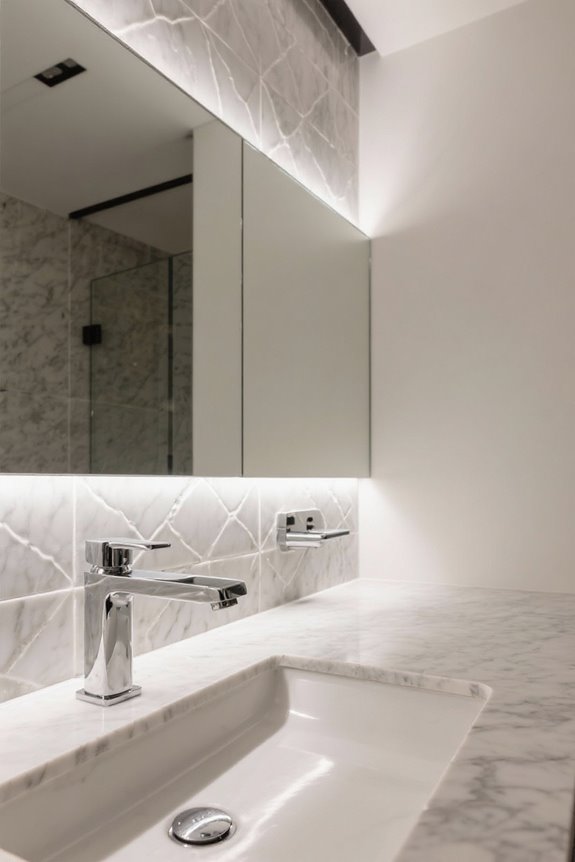
When considering how to calculate the ideal lumens for bathroom lighting, it is essential to utilize a systematic approach that combines the room’s square footage with a recommended foot-candle requirement, typically ranging from 70 to 100 foot-candles. To determine the required lumens, one must multiply the bathroom’s area, measured in square feet, by the appropriate foot-candle value, resulting in lumens per square foot. For instance, a 50 square foot bathroom aims for a total output between 3,500 to 5,000 lumens, catering to diverse lighting design needs. Small bathrooms (up to 40 sq ft) require 1,500 to 2,000 lumens, while larger spaces may need between 4,000 to 8,000 lumens, ensuring maximum visibility and functionality. Console sinks, with their durable construction and compact designs, can significantly enhance the overall bathroom experience, complementing the lighting setup with their stylish and practical features.
Small Bathrooms: Ideal Lumen Targets
In small bathrooms, which are defined as spaces up to 40 square feet, the ideal lumen target ranges from 1,500 to 2,000 lumens, ensuring sufficient brightness for essential tasks. Achieving adequate brightness is vital for activities such as shaving or applying makeup, where precision is key. To meet the lumens you need, wall sconces or mirror-mounted lights can be effective, as they provide even illumination across the face, minimizing harsh shadows. Additionally, natural light from windows may reduce the requirement for artificial lighting, allowing for a cozier atmosphere. Balancing task and ambient lighting is essential in small bathrooms, enhancing functionality while contributing to a visually appealing space. Proper lighting notably elevates the overall user experience. When selecting bathroom lighting, ensure that fixtures are moisture-resistant, as this enhances durability and safety in humid environments.
Medium-Sized Bathrooms: Lumen Guidelines
For medium-sized bathrooms, which typically range from 40 to 100 square feet, a well-planned lighting approach is essential, as the recommended lumen output falls between 2,000 and 4,000 lumens, ensuring that various activities, such as grooming and applying skincare products, can be performed effectively. A combination of ambient lighting and task lighting is vital; for example, installing wall sconces and overhead fixtures can improve overall light distribution. Task lighting should be strategically positioned around the vanity area to enhance visibility during personal care routines. Additionally, using LED bulbs is advisable, as they provide high lumen output per watt, contribute to energy efficiency, and generate less heat compared to traditional incandescent options. Selecting appropriate CRI (above 80) ensures color accuracy, improving the visual appeal of the bathroom.
Recommended Products

SCULPTURAL CENTREPIECE — The Paget unites 9 LED lights across a 20-inch chrome chandelier frame in a transitional, considered composition. A chrome multi-light chandelier sized to anchor a dining room or entryway.

Brighter & Energy-Saving – Equipped with a high-density, UL-listed waterproof LED strip (120 LEDs/meter, CRI>90), combined with high light transmittance (>95%) acrylic lamp cover, it delivers a lighting experience that achieves both energy efficiency and brightness with lower wattage.

DESIGN STATEMENT — The Ferro unites 5 LED lights across a 21-inch black chandelier frame in a transitional, considered composition. Inspired by shadow box wall art, multiple cubes are positioned in dimensional patterns and illuminated by LED panels to create a dramatic visual effect. A black pendant chandelier sized to anchor a dining room or kitchen.
Large Bathrooms: Achieving Proper Illumination
Achieving proper illumination in large bathrooms, which typically exceed 100 square feet, necessitates a strategic balance of light sources to meet the recommended lumen output of 4,000 to 8,000 lumens, enabling comfortable visibility for various tasks. To calculate the required lumens, one can multiply the bathroom’s square footage by a foot-candle requirement of 70-100. It is essential to incorporate both ambient lighting and focused task lighting around mirrors, as this maximizes functionality and minimizes shadows in large bathrooms. Additionally, selecting moisture-rated lighting fixtures for wet zones enhances safety and longevity. A color temperature between 2700K and 3000K strikes the ideal balance between brightness and warmth, fostering a comfortable and inviting atmosphere throughout the space. Many high-quality shower filters offer easy, tool-free installation that makes them user-friendly and accessible for most standard shower systems.
Recommended Products

💡【Edge-Lit Innovation Full Mirror Premium Glow】Unlike central-strip designs that reduce usable mirror area, our outer-edge sandblasted frosted LED strip maximizes mirror space for clear, unobstructed grooming. More decorative than lamp-shaded styles, it maintains elegant aesthetics when lit or off. To address the common dimness issue in sandblasted strips, we widened it to 1 inch—delivering both premium aesthetics and bright, cozy bathroom lighting in one.
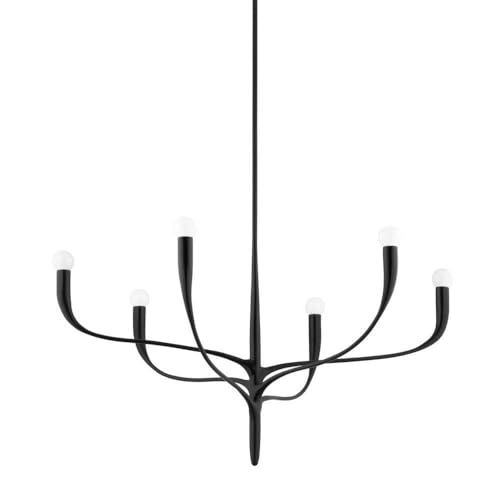
Finish: Aged Iron

Finish: Aged Brass - Glass: Etched/White Frosted
Selecting the Right Light Bulb for Your Bathroom
Selecting the appropriate light bulb for a bathroom involves understanding a variety of factors, including energy efficiency, color temperature, and overall lumens output needed for effective illumination. LED bulbs stand out for their ability to provide higher lumens per watt, making them energy-efficient choices. For adequate brightness, small bathrooms should aim for 1,500 to 2,000 lumens, while larger bathrooms may need between 4,000 to 8,000 lumens. To enhance vanity lighting, it is critical to choose bulbs with a high Color Rendering Index (CRI) of 90 or above, ensuring accurate color perception for grooming tasks. Additionally, selecting moisture-rated fixtures and bulbs is essential for safety, protecting against potential damage in wet areas frequently exposed to water. Motion sensor lights can also provide additional convenience and energy savings in bathroom spaces by automatically turning on and off, adapting to user presence.
Recommended Products

✅LED FRONTLIT MIRROR: The Lighted Vanity mirror features LED light that creates bright yet energy-efficient illumination. Our long-lasting LED provides 50,000 hours of use.

✅LED BACKLIT MIRROR WITH CABINET: The mirror features cabinets that open with three mirrored doors opening towards left, left, and right. The extreme right and extreme left cabinets are lighted.

SCULPTURAL CENTREPIECE — The Trento unites 7 LED lights across a 25-inch gold chandelier frame in a modern, considered composition. Intricate champagne silver or antique gold frames delicately hand strung glass wafers. A gold pendant chandelier sized to anchor a dining room or entryway.
Color Temperature and Its Role in Bathroom Lighting
Color temperature plays an essential role in bathroom lighting, influencing both functionality and ambiance. Typically, ideal color temperatures range from 2700K to 3000K, providing a warm, natural light that supports effective grooming tasks. Cooler color temperatures, ranging from 4000K to 5000K, enhance brightness perception, yet they might not be as flattering for personal care activities. The correlated color temperature (CCT) impacts ambiance; warm tones create a calming environment, while cooler tones can energize a space. Additionally, selecting bulbs with a high Color Rendering Index (CRI) of 90 or above guarantees accurate color representation, imperative for tasks like makeup application and shaving. Properly chosen color temperatures can also reduce the required lumens, as cooler tones appear brighter at lower outputs.
Common Mistakes to Avoid in Bathroom Lighting
Effective bathroom lighting is not solely about choosing the right color temperature; it also involves avoiding common mistakes that can lead to inadequate illumination and compromised functionality. One prevalent error is using too few fixtures, resulting in insufficient light output, which diminishes safety during grooming tasks. Furthermore, placing vanity lights too high can cast unwanted shadows on the face, complicating activities like shaving or applying makeup. Selecting fixtures focused on aesthetics rather than illumination can also hinder functionality. Additionally, failing to balance ambient lighting with task lighting often leaves areas, particularly around mirrors, poorly lit. Finally, neglecting dimmable options limits flexibility in adjusting brightness levels, essential for creating a versatile, comfortable bathroom environment. To enhance bathroom safety, consider using non-slip features in high-moisture areas to prevent accidents.
Tips for Proper Placement of Bathroom Vanity Lights
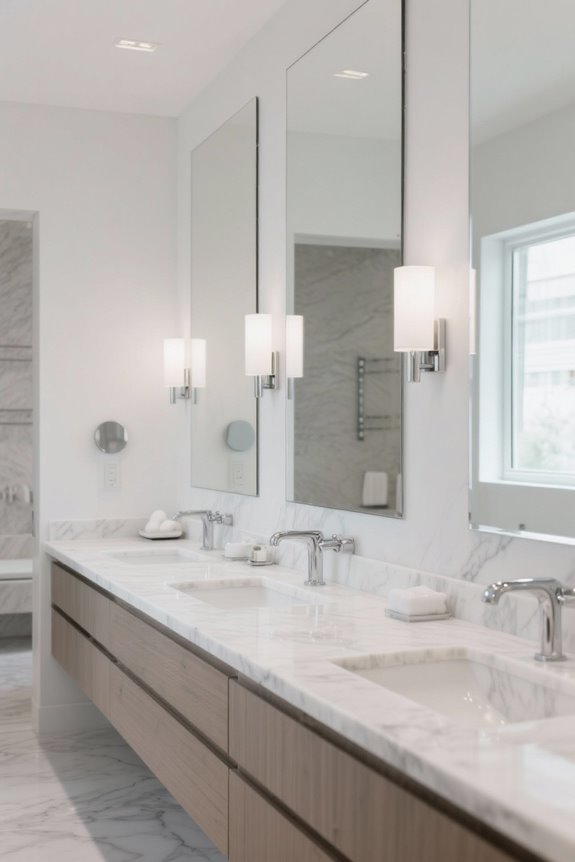
When planning the placement of bathroom vanity lights, several critical factors should be considered to guarantee ideal functionality and aesthetic appeal. Vanity lights should be positioned at eye level, ideally between 65 to 70 inches from the floor, to minimize shadows that can interfere with grooming tasks. It’s important to space sconces 36 to 40 inches apart, ensuring even light distribution and eliminating dark corners near the mirror. Additionally, an overhead light should be centered above the mirror to provide balanced illumination that complements side fixtures effectively. Avoid placing lights too high, as this creates unflattering shadows. Dimmable fixtures can offer adjustable brightness, catering to varying times of day and desired ambiance, enhancing the overall effectiveness of the lighting setup.
Frequently Asked Questions
How Many Lumens Do I Need for a Small Bathroom?
For effective bathroom lighting in a small space, 1,500 to 2,000 lumens are ideal. Proper fixture placement, including eye-level lighting and thoughtful task areas, enhances brightness while minimizing shadows and improving overall illumination.
Is 1500 Lumens Too Bright for a Bathroom?
Lighting a bathroom can resemble tuning an instrument; 1,500 lumens might not be overly bright, yet it can disrupt vision comfort. Balancing light intensity cultivates the perfect bathroom ambiance, ensuring a harmonious start to each day.
Is 1200 Lumens Enough for a Bathroom?
No, 1,200 lumens is insufficient for a bathroom. Effective ambient lighting options, strategic fixture placement, and appropriate color temperature effects are essential for achieving ideal illumination, enhancing both functionality and aesthetics in the space.
Is 3000K or 4000K Better for Bathrooms?
In a color temperature comparison, 3000K creates a warm, relaxing atmosphere, while 4000K offers bright, neutral lighting beneficial for grooming. Fixture placement greatly influences lighting mood effects and should complement the chosen temperature for ideal performance.